Chapter 4 Caliper vs. Calc
Over the years, I have observed that beginning echocardiographers may have difficulty for a long time distinguishing between the following two measurement methods:
- “Unnamed” measurement of some parameter using the Caliper button
- Structurally performed measurement using parameters found behind the Calc button
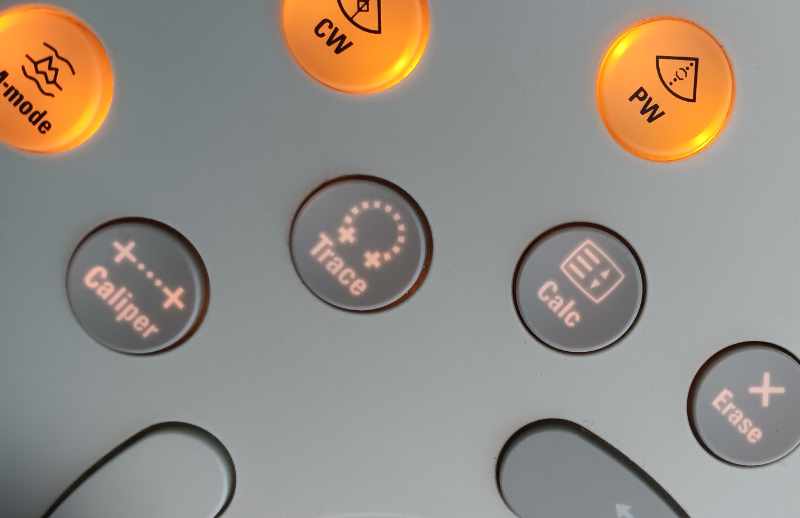
Figure 4.1: Caliper and Calc buttons.
The only difference between the measurement methods is that from a measurement made with the Caliper button, only the measurer themselves, that is, the echocardiographer, knows what was measured.
If you want the echocardiography device to calculate, for example, the ejection fraction, you must measure structurally with the device - by searching for parameters behind the Calc button - the following measurements:
- LVIDd (left ventricular diameter in diastole)
- LVIDs (left ventricular diameter in systole)
Immediately when these measurements are made structurally, the echocardiography device automatically displays the left ventricular ejection fraction on the screen, whether the echocardiographer requested it or not.
If, on the other hand, you measure each of the aforementioned dimensions with the Caliper button, this appears to the device as follows:
- Some unknown Caliper measurement was just made
- Then some other unknown Caliper measurement was made
In practical work, an experienced echocardiographer and clinician may perform several examinations consecutively, especially during rounds, using only the Caliper function for its speed, while still gaining sufficient understanding of clinically significant echocardiographic findings for both report preparation and actual treatment.
Typical measurements that can be quickly checked “unnamed” with the Caliper button:
- Left ventricular diameter
- if you just look at this with the Caliper button, the echocardiographer naturally has no intention of measuring the ejection fraction with the echocardiography device
- Aortic and left atrial diameters
- Maximum gradient measured across the aortic valve with continuous wave Doppler
- Tricuspid gradient
- TAPSE
Typical measurements that are often wanted to be marked structurally using parameters found behind the Calc button:
- Left ventricular diameter in diastole and systole
- when you want the echocardiography device to calculate the ejection fraction
- E-, A-, and e’-waves
- when you want the echocardiography device to perform diastology calculations
- Flow velocities measured across the aortic valve and from the left ventricular outflow tract, as well as the outflow tract diameter
- when you want the echocardiography device to calculate the aortic valve area (AVA)
Echo Guidebook © 2022 by Ville Langén is licensed under CC BY-SA 4.0

